By Julian Fischer-Lhamon
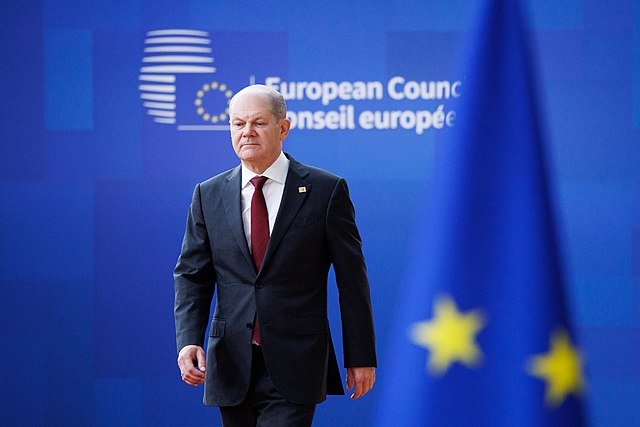
After fourteen years, a German Chancellor has finally visited Kazakhstan again. Olaf Scholz’s visit was highly anticipated, with groundwork being laid already last year with a visit by Germany’s foreign minister and president. Scholz met with not only Kazakhstan’s president, Tokayev, but also leaders of the other central Asian countries. Despite other European leaders visiting the country previously, such as France’s Macron or Hungary’s Orban, Scholz’s visit marks the strengthening of the first “regional strategic partnership” between Europe and Central Asia (C5+Germany).
Central Asia is one of crucial strategic importance. Historically it has formed an important element of “the Great Game” between the Russian and British Empires as the two jockeyed over control of Central Asia, Persia, and routes into India. In the modern era, Central Asia is no less important, flanking Russia’s south, Iran’s north, and China’s west. For these reasons, although Central Asia looks to be of promising strategic importance, the western coalition (NATO, EU countries, the U.S.) must be prepared to extract only limited concessions out of Central Asia due to the pressure they face from their neighbors (as evidenced by Tokayev claiming Russian victory in the Ukraine is inevitable). Even if these Central Asian countries are interested in pursuing closer ties, the West must be wary of any reactions this could provoke out of the neighboring rival powers.
However, it appears that Germany is more interested in leveraging Central Asia to help solve its own domestic problems. Germany’s sanctions on Russia, for which it has historically greatly relied on for cheap energy (after turning away from nuclear), led to an energy shock. This, in turn, provoked a nasty wave of inflation and a decline in manufacturing. Germany’s manufacturing woes are serious. In 2023, production dropped by 1.2 percent in real terms, while overall output is down 9 percent from 2018. Unfortunately, this decline is projected to continue. Germany has tried to shore up the energy issue by increasing energy imports from Kazakhstan who has become Germany’s third-largest supplier of crude oil. Curiously, Scholz did not accept the Kazakh offer for more barrels at their meeting this week, instead focusing on green hydrogen, hydroelectric, and lithium from Central Asia.
Perhaps just as important as energy is the question of migration in the mind of Scholz’s government. Last month, the far-right AFD outperformed all other parties in two German state elections, fueled by an increasingly suspicious and wary public sentiment towards migration. Scholz appears to have used his visit in order to help address these concerns by negotiating with Uzbekistan for help with the deportation of denied Afghan asylum seekers back to Afghanistan (the German government does not recognize the Taliban government and thus needs a middle man). In return, Germany has offered work visas for Uzbek migrants, but the lack of any indication of numbers or integration into the Germany society or economy show this to be a bargaining chip than any real interest on the German side. As time goes on and the East-West rivalry intensifies, Central Asia will become ever more important and skilled leaders will be able to play both sides to the benefit and prosperity of their countries.
 The Patterson Journal of International Affairs
Leave a comment