By John W. Parks
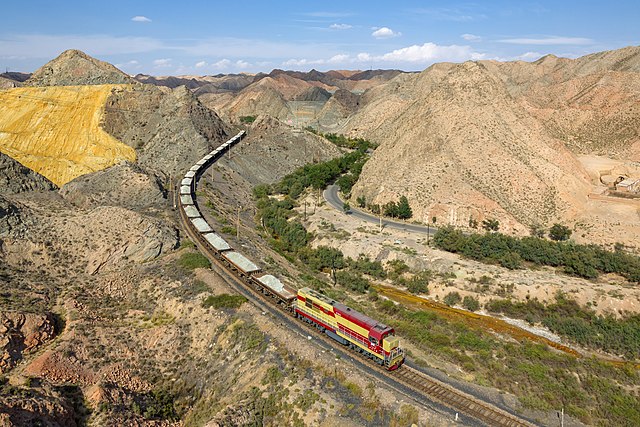
As of November 2024, construction has begun on the China-Kyrgyzstan-Uzbekistan Railroad (CKU) inside Kyrgyzstan. The railroad will connect the Uzbek terminal of Andijan to the Chinese terminal of Kashgar, passing through several Kyrgyz cities and the Fergana Valley along the way. Leaders of these countries have championed the construction of this railroad, though its planning began nearly thirty years ago in 1996. Perhaps most emphatically, Kyrgyzstan President Sadyr Japarov claimed with the CKU, “we will become a transit country for the world.” The eventual completion of this railroad is a restoration of the ancient Silk Road that will profoundly impact economies around the globe and geopolitical relationship.
The construction and completion of the CKU will alter the face of the Central Asian states in several ways. Physically, the region will have over 450 kilometers of new rail networks, including many bridges, tunnels, and a rail-gauge changing station in Kyrgyzstan. Construction of these elements will provide an influx of jobs for Kyrgyzstan, as well as future jobs to operate the completed network. The CKU is also part of a Build-Operate-Transfer agreement, meaning that once the railroad has paid back construction loans, the ownership will be transferred to the Kyrgyzstan government from China. Following completion, the CKU will have an operational capacity of 15 million tons per year, though Central Asian exports and Chinese exports will have to compete for this space.
Central Asia will have significantly easier access to Europe and Chinese coastal ports because of the CKU Railroad. The Andijan and Kashgar terminals link into existing railways that facilitate trade to Europe, the Middle East, and Russia. Similarly, connections at Kashgar will provide Central Asia with a direct link to Chinese coastal ports without the traditional connection that required transport through Russia. The CKU represents a significant geopolitical change in Central Asia. Owing to the trade bottlenecks of Russia’s war in Ukraine and Houthi disruption in the Red Sea, a middle route between China and Europe will likely change the dominant power in Central Asia. By using the CKU instead of the Trans-Siberian Railroad to transport goods, the journey between Europe and China will be 900 kilometers and eight days shorter than the traditional route, thus removing Russia from the chain. Questions over the rail-gauge for the project also threatened to decrease Russian influence in the region as Kyrgyzstan and Uzbekistan use the Russian gauge. Experts claim the CKU signals an increase in Chinese influence, not an ability for Central Asia to reach the world markets. Nonetheless, the construction of the China-Kyrgyzstan-Uzbekistan Railroad is a significant development for the region
 The Patterson Journal of International Affairs
Leave a comment