Prime Minister’s Office (GODL-India), GODL-India https://data.gov.in/sites/default/files/Gazette_Notification_OGDL.pdf, via Wikimedia Commons

By Brooke Bihl
Canada’s Prime Minister, Mark Carney, recently completed a nine-day trip across Asia aimed at strengthening trade relationships and deepening bonds among middle powers by visiting India, Australia, and Japan. This comes after Carney announced late last year that Canada intends to double its non-U.S. exports in the next decade due to President Trump’s array of tariffs, which placed a 35% tax on most Canadian products. President Trump further intensified the feud by threatening to impose a 100% tariff on Canada’s proposed trade deal with China and claiming Canada could be the “51st state.” The tour marks Carney’s first international trip since his headline-making speech at the World Economic Forum in Davos, which called on global “middle powers” to band together against “American hegemony” and the efforts of great powers to coerce and subjugate other countries.
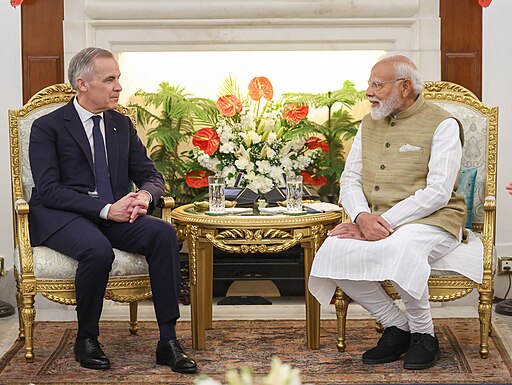
Prime Minister Carney’s first stop, and perhaps most important of the trip, was in New Delhi, where he met with Prime Minister Narendra Modi of India. The meeting comes just a year after Carney’s predecessor, Justin Trudeau, disclosed that Canadian intelligence believed Indian diplomats in Canada, under orders from the Indian government, had helped plan political assassinations and intimidation campaigns targeting Sikhs on Canadian soil. However, the meeting between the two leaders held no mention of the incident that left a diplomatic rupture between both countries, but instead focused on renewing the relationship and resuming uranium shipments to India, which is valued at about $1.8 billion dollars and set to run from 2027 to 2035. Mr. Carney’s second stop was in Australia, where he reaffirmed his strong relationship with Australia’s prime minister, Anthony Albanese, and spoke in front of parliament to build on the speech he gave in Davos: “Middle powers like Australia and Canada hold this rare convening power. Because others know we mean what we say, and we will match our values with our actions.” During his speech, Carney stated the two countries had signed a series of agreements on critical minerals, including Australia joining the G7 critical minerals alliance.
Carney’s third and final stop was in Tokyo, where he met with Japanese Premier Sanae Takaichi and laid out six priority areas, including: enhancement of security and defense co-operation through shared information, technology transfers, co-operation in maritime security, and the strengthening of economic security with robust supply chains. In addition to deepening diplomatic ties, the two countries committed to carrying out more joint military exercises in the region and co-developing AI products. Amid ongoing uncertainty over the future of U.S.-Canada relations, Carney has made it a top priority to garner deals with other countries in order to diversify trade and shore up the economy.
 The Patterson Journal of International Affairs
Leave a comment