Khamenei.ir, CC BY 4.0 https://creativecommons.org/licenses/by/4.0, via Wikimedia Commons

By Mia Durham
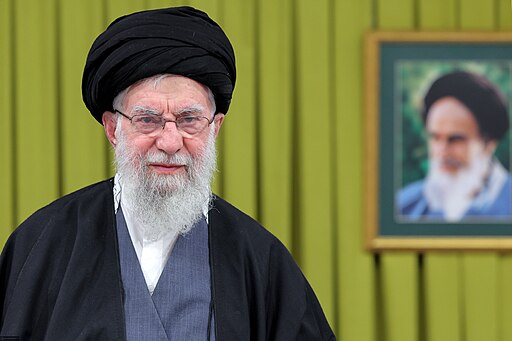
On February 28th, the United States and Israel conducted coordinated airstrikes on Iran. President Trump claimed that the goals of the operation were to encourage the removal of the authoritarian Ayatollah Ali Khamenei regime, to remove all of Iran’s nuclear and missile capabilities, and to destroy the Iranian navy. The United States’ led-offensive attack targeted multiple cities across Iran and struck military sites, missile production facilities, Islamic Revolutionary Guard Corps (IRGC) command centers, and infrastructure linked to expanding Tehran’s missile and drone programs. Among these, one of the most consequential targets was the compound of Supreme Leader Khamenei. Both Iranian media and President Trump confirmed the death of Khamenei, along with much of Iran’s key senior leadership and three American soldiers. Additionally, in an attempt to attack a naval military base, the United States and Israel struck a girls’ elementary school, killing and injuring at least 150 people, the majority of them children, creating grave humanitarian concerns.
Iranian President Pezeshkian has characterized the strikes as a “historic crime” and declared that retaliation is a legitimate duty and a sovereign right. Within hours, Tehran launched ballistic missiles and armed drones aimed at U.S.military bases located in various Gulf Arab countries and Israel. Attacks and attempted attacks occurred in Qatar, the UAE, Bahrain, Kuwait, and Jordan, resulting in a few casualties and infrastructure damage in the various nations.
President Trump, in a statement confirming the military action, urged Iranians to “take over [their] government” and for the IRGC to “lay down [their] weapons.” The IRGC is deeply organizationally embedded in the regime and is seen as a political and economic pillar of the state. Therefore, the decapitation of the leadership is unlikely to topple the regime and could even strengthen unity within the military and consolidate hardline factions. Furthermore, the Iranian people, although politically diverse, are not militarily equipped to face a military as advanced as the IRGC. The decapitation of the Iranian leadership will possibly further destabilize the region.
Beyond regime dynamics, a concern coming out of these attacks is a possible escalation of nuclear weaponization as a deterrent against future interventions. This conflict also threatens global oil markets, specifically in maritime routes near the Strait of Hormuz, which supplies large amounts of the world’s energy. There has already been a 10% jump in oil prices, which will continue to rise if the conflict continues. Any further involvement or efforts made by the United States will intensify threats to U.S. security both abroad and at home, strain alliances with neighboring countries, threaten energy access, and continue to escalate the regional conflict.
 The Patterson Journal of International Affairs
Leave a comment