By John W. Parks
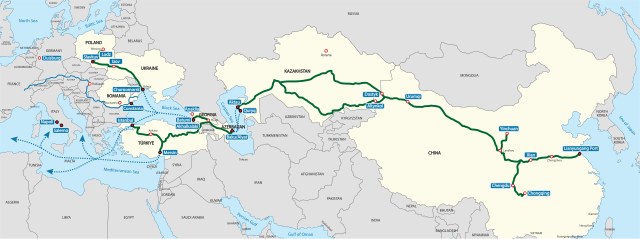
As war in Ukraine continues to damage Russia’s credibility and economic security, other Eurasian producers have been forced to utilize alternative avenues of trade. In response, China, along with Turkey, the European Union, and Central Asian states have dedicated increasingly more resources to the development and expansion of a bypass route. The Trans-Caspian International Transport Route (TITR), also called Middle Corridor, is the multimodal alternative bolstered by these states seeking to exclude Russia from traditional routes. Initial successes with the Middle Corridor have become clear indicators for the significance TITR holds over the global trade status quo.
The TITR is built on the premise that the traditional northern route through Russia is not the most efficient direct route between Europe and the Far East. In 2013, Azerbaijan, Georgia, Kazakhstan, and Turkey launched the Middle Corridor project which has since expanded to air, land, and sea routes that traverse China, Central Asia, Europe, the Black Sea, and the Caspian Sea. China, being the largest producer-state using the TITR, initially did not support the route due to strengthening ties with Russia and regional security threats like the Nagorno-Karabakh conflict. However, due to the supply-chain alteration caused by the Russian invasion of Ukraine, China has since signed agreements with Georgia and Kazakhstan to expand the capabilities of the Middle Corridor. China also stands to use the TITR as a vehicle for expansion of its Belt and Road Initiative (BRI) and Central Asian influence.
In its current state, the TITR can transport one forty-foot equivalent unit shipping container (FEU) for $2,500 to $3,250 USD, which are similar prices to the northern route. Goods require 18 to 23 days to travel the length of the Middle Corridor route compared to the 19 days required for travel on the northern route. Though the times and pricing are nearly equal between the two routes, states are cooperating to make the TITR more appealing to customers. The current rates are results of the infrastructure issues that affect the young project. Delays are typically caused by intermodal transfer centers that need upgrading to manage the larger volume of shipments. It is estimated the TITR requires 18.5 billion euros in investment to sufficiently develop the project to align with its projected growth.
Despite the infrastructure challenges, the Trans-Caspian International Transport Route is rapidly growing out of its infancy. The amount of twenty-foot equivalent units (TEU) shipped on the route grew 25 times larger between 2023 and 2024 and is expected to reach 130,000 TEU yearly by 2040. As Europe and China rely on their market cooperation, and the reluctance to use traditional Russian routes persists, the exponential growth of the TITR looks as promising as it does likely. Nonetheless, the TITR represents a shift in the arena of global trade that will be central to the economies of the twenty-first century.
 The Patterson Journal of International Affairs
Leave a comment