By Abby Bedard
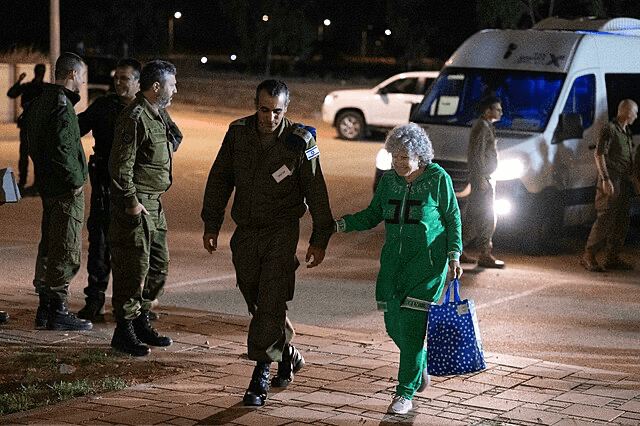
Saturday, February 1st saw the fourth hostage-prisoner exchange of the Israel-Hamas ceasefire deal. 183 Palestinian prisoners were exchanged for three Israeli hostages, Ofer Kalderon, Yarden Bibas and Keith Siegel. Hamas handed the hostages over to the Red Cross in two choreographed events in Khan Younis and Gaza City. The exchanges went forward without the chaos of Thursday’s hand off, which saw surging crowds at the release of Arbel Yehoud. The Israeli government delayed the release of 110 Palestinian prisoners in response to the tumultuous scene, with Prime Minister Benjamin Netanyahu calling for the death of anyone that harmed a hostage.
The release of three male prisoners today has raised concerns that any remaining women and children in Hamas custody may not be alive, including Shiri, Ariel and Kfir Bibas, Yarden Bibas’s wife and children. Kfir Bibas was just nine months old when he was abducted from his home in Kibbutz Nir Oz alongside his mother Shiri and older brother Ariel and has since become one of the most recognizable Israeli hostages. Hamas officials released a statement back in November 2023, stating that Shiri, Ariel and Kfir were killed in an Israeli airstrike. These claims were never confirmed by the Israeli government, leading many to hope that the three still lived. The fact that the three have not been released up to this point in the ceasefire signals that those hopes were likely in vain.
Scenes of joy unfolded elsewhere as busloads of freed Palestinian prisoners arrived in Ramallah in the West Bank and Khan Younis in Gaza, but for many, the occasion was bittersweet. Several of the prisoners released today, like Shadi Amouri, were sent into exile, rather than released back to his home in Jenin. Amouri was arrested for his alleged role in the construction of a car bomb that killed 17 Israelis in the Megiddo Junction Suicide bombing. Basil Farraj, an analyst at Birzeit University also stated that Israel is likely to re-arrest some of those released, as evidenced following the November 2024 hostage-prisoner exchange.
Further south, the first phase of the ceasefire continues as the Rafah crossing opens for the first time in nine months. Gaza’s Health Ministry reported that 111 individuals, 50 patients and 61 caregivers crossed from Rafah to Egypt to receive medical care on Saturday. While approximately 400 Palestinians are slated to leave Gaza to seek medical treatment abroad, this number falls gravely short of the need. Director of Hospitals in Gaza’s Health Ministry, Mohammed Zaqout, stated that more than 12,000 Palestinians are currently in dire need of medical treatment. Many Palestinians are hopeful that the number allowed through the crossing will rise if the ceasefire continues to hold. Negotiations for phase two of the ceasefire are set to begin by day 16 of phase one.
 The Patterson Journal of International Affairs
Leave a comment